
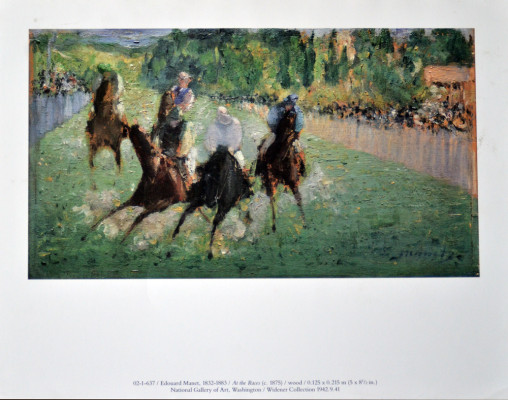
Édouard Manet 1832-1883 Print ‘At the Races’ 1875
His family were affluent and well connected, his mother was the daughter of a diplomat and his father a judge. He had two younger brothers. It was his uncle Edmond Fournier from his mother’s side, who encouraged him to pursue painting. His father would have preferred him to enter law school and follow his eminent career. His father then suggested the Navy and put him on a sail-training vessel to Rio de Janerio. He failed his Navy examinations. So art it was to be.
He admired Velazquez and the great Titan and Francisco de Goya, and was influenced by Frans Hals and then Courbet introducing him to the current style of realism.
He had two canvases accepted by the Paris Salon in 1861. Le Déjeuner sur l’herbe, which was rejected in 1863 went on to be hung in the salon des Refuses, the painting caused a stir in the minds of Emile Zola, the writer and also Proust. The painting failed to sell but became a corner stone of his work. He produced Olympia, which was shocking in the way it showed a women with an orchid in her hair and not voluptuous but thin, the black servant introduced a sexual tension into the piece. The avant-garde community loved it and it placed Manet well into the framework of the current art movement. He was not a man to do much painting outside, but finally did work outdoors and it altered his management of light and shadow, and lifted the paintings, but he always considered them to be less serious than those completed in his studio.
In 1864 he painted the races at Longchamp, but he is perhaps best known for the Bar at the Follies-Bergère. This painting is brilliant because what you think you see is not what you are looking at. The girl in what looks like a mirror is not the back of the girl looking out at you. A genius of a painting, and one that has always enchanted me. He is regarded at the father of modernism.
National Gallery of Art, Washington/ Widener Collection 1942
Studied at Camberwell School of Art.